Human beings naturally seek comfort, yet every notable mind in history was forged through resistance. Smooth stones are quiet, but they are unremarkable; only the pressure of the tumbler reveals the hidden brilliance within the mineral. Roman philosopher Seneca understood that comfort is often the enemy of genuine personal growth. As he famously observed:
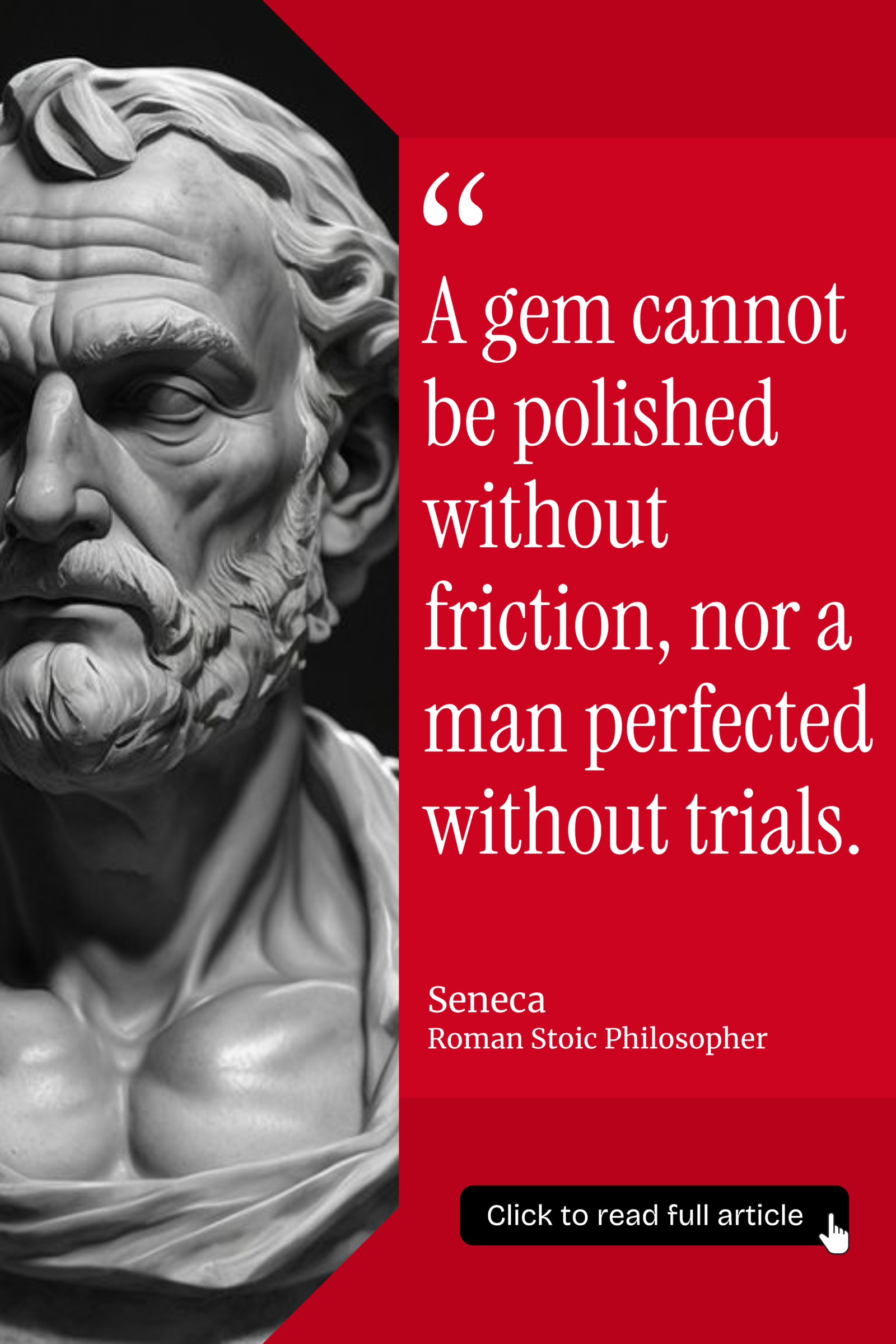
“A gem cannot be polished without friction, nor a man perfected without trials.”
What Did Seneca Mean by This?
Seneca drew a sharp distinction between passive existence and active refinement. A gemstone in its raw state holds intrinsic value, but it looks like an ordinary rock until an aggressive external force cuts away its rough exterior. In Seneca’s view, human potential works precisely the same way: talent alone is mere raw material, worthless until tested by circumstance.
He was not glorifying suffering for its own sake. Rather, he viewed hardship as a necessary tool for personal growth. Just as a lapidary uses friction to turn rough mineral into a brilliant jewel, life uses adversity to shape character and deepen wisdom. Without resistance, our best qualities remain hidden beneath the surface.
Who Was Lucius Annaeus Seneca?
Lucius Annaeus Seneca, known simply as Seneca the Younger, was a prominent Stoic philosopher, statesman, and dramatist in Ancient Rome. Living during the turbulent first century, he served as an advisor to the unpredictable Emperor Nero. His life was defined by extreme wealth and political power, balanced constantly against the fragile threat of exile and execution.
Despite his immense status, Seneca wrestled continuously with ethical compromises and personal tragedy. He wrote extensively about resilience, emotional mastery, and the inevitability of suffering. His practical philosophy ended up surviving his execution by Nero, proving that his inner strength matched his written words. His life demonstrated that hardship is not an interruption to character, but its true test.
Why Seneca’s Words Still Cut Deep
Modern culture promises efficiency and frictionless living at every turn. We optimize our schedules to eliminate inconvenience, yet this artificial ease often leaves us ill-equipped for real crises. When unexpected hardship arrives, our lack of practice with difficulty makes small obstacles feel overwhelming.
Seneca’s insight cuts directly through our contemporary illusion of effortless achievement. When a project fails, a relationship hits turbulence, or a career shifts, our impulse is to view the event as an unfair interruption. Viewing those same moments through Seneca’s lens converts pain into preparation. Resistance is not a sign that you are on the wrong path; it is the friction required to refine your character.
What This Quote Is Really Asking of You
This philosophy asks you to stop viewing difficulty as a flaw in your life’s design. It invites you to welcome discomfort as a necessary sculptor rather than an unwanted intruder. The next time you face a painful setback, reframe the experience not as an injury, but as the precise pressure required to reveal your strength.
Are you attempting to build a meaningful life while running away from the very friction that creates it?









Comments0
Sign in to join the conversation
Share your perspectives and engage with other readers.